Big Data and AI Prediction
We build questionnaire datasets, variable dictionaries, network analyses, machine-learning prediction models, and interpretable models for addiction, obesity, self-harm, sleep, and emotional risk.
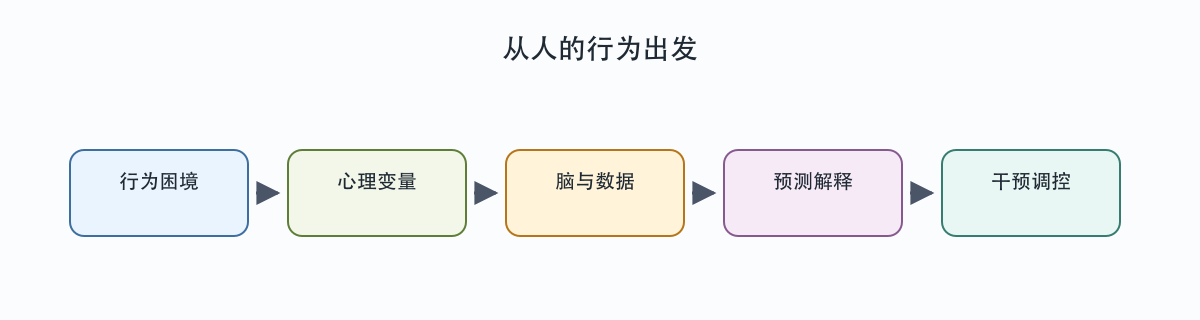
We start from real behavioral difficulties and turn “I cannot stop,” “I want it but I do not enjoy it,” and “why treatment works or fails” into measurable, modelable, and intervention-ready scientific questions.
What NRLab Studies
NRLab focuses on addiction, digital behavior, eating and obesity, adolescent mental health, psychiatric symptoms, and neuromodulation interventions. Many questions begin with daily experience: gaming that becomes difficult to stop, cues that repeatedly trigger craving, social media evaluation pressure, or unstable behavioral trajectories after treatment.
The lab does not stop at description. Behavioral tasks record choices, scales capture symptoms and craving, fMRI and EEG describe brain networks, computational models compress choice trajectories into parameters, and interventions such as rTMS, tDCS, MST, focused ultrasound, and TI place targets, brain signals, symptom change, and long-term outcomes into one testable chain.
We enter science through human behavioral difficulties and return with research paths that are measurable, modelable, intervention-ready, and reproducible.
Craving, impulsivity, sleep, social stress, and digital behavior.
Scales, behavioral tasks, cue reactivity, and longitudinal tracking.
fMRI, EEG, network analysis, machine learning, and computational models.
Neuromodulation, RCTs, response prediction, and follow-up outcomes.
Research Programs
We build questionnaire datasets, variable dictionaries, network analyses, machine-learning prediction models, and interpretable models for addiction, obesity, self-harm, sleep, and emotional risk.
We study brain networks, symptom change, stimulation targets, and treatment response under interventions such as rTMS, tDCS, MST, focused ultrasound, and TI.
We analyze social interaction, social isolation, loneliness, family relationships, and peer relationships through behavioral tasks, questionnaires, and longitudinal data.
We use time-series features such as phone behavior, nighttime use, rhythm, and app switching to understand mental states and risk subgroups in digital environments.
Team & Platform
The platform has accumulated multi-center mental health questionnaire data, neuroimaging data, clinical trial data, and behavioral experiment data. The research workflow covers question formulation, data cleaning, variable dictionaries, preregistration, statistical modeling, figures, manuscript drafting, revision, and submission.
Over the past five years, team members have published first-author or corresponding-author papers in journals such as Med, Cell Reports Medicine, Molecular Psychiatry, Biological Psychiatry, Computers in Human Behavior, and Journal of Affective Disorders.
National Regional Medical Center for Mental Health; the primary research site. It uses province-wide clinical resources to support psychiatric assessment, intervention, and long-term follow-up.
National Center for Mental Health; the institution providing development support for the primary research site. It supports collaboration in psychiatry, neuromodulation, clinical trials, and multimodal assessment.
Joint institutions supporting mental health research, neuroimaging, clinical assessment, and cross-center collaboration.
Graduate enrollment institutions recruiting master's students in Psychiatry and Mental Health, and Psychology.
Selected Publications
Authorship notes list only NRLab faculty-related authors and specify first-author, co-first-author, corresponding-author, last-author, or author-order roles when clear.
Journal of Affective Disorders · Faculty authorship: Ziliang Wang, Hui Zheng, and Qiang Hu (listed authors)
Molecular Psychiatry · Faculty authorship: Ningning Zeng (co-first author); Min Wang (co-corresponding author); Hui Zheng (co-corresponding and last author)
Nature Communications · Faculty authorship: Ningning Zeng, Min Wang, and Hui Zheng (co-first authors); Xiong Jiao and Ziliang Wang (listed authors); Qiang Hu (corresponding and last author)
Biological Psychiatry · Faculty authorship: Ningning Zeng (listed author); Hui Zheng (co-corresponding author); Min Wang (last author)
Translational Psychiatry · Faculty authorship: Qiang Hu (co-first author); Ningning Zeng, Min Wang, and Ziliang Wang (listed authors); Xiong Jiao (corresponding author)
Journal of Affective Disorders · Faculty authorship: Hui Zheng and Qiang Hu (co-corresponding authors)
Biological Psychiatry: Cognitive Neuroscience and Neuroimaging · Faculty authorship: Min Wang and Ningning Zeng (co-first authors); Hui Zheng (listed author)
Progress in Neuro-Psychopharmacology and Biological Psychiatry · Faculty authorship: Hui Zheng (first author); Min Wang and Ziliang Wang (listed authors)
Computers in Human Behavior · Faculty authorship: Qiang Hu and Hui Zheng (listed authors); Ziliang Wang (last author)
Computers in Human Behavior · Faculty authorship: Hui Zheng (last author)
Med · Faculty authorship: Hui Zheng (co-first author)
Biological Psychiatry · Faculty authorship: Xiong Jiao (first author); Qiang Hu (second author)
Translational Psychiatry · Faculty authorship: Hui Zheng (corresponding and last author)
Public Outreach
Outreach is organized along three axes: content source, channel, and final product. The current workflow activates WeChat long-form graphics and Xiaohongshu card sets. All materials share one communication rule: make the judgment first, provide evidence, then translate it into action.
The content avoids slogans. It turns lab research, strong recent papers, academic writing, research tools, and submission workflows into materials that students can keep reading, checking, and practicing.
Join NRLab
Maintain and debug questionnaire data pipelines, organize variable descriptions, data dictionaries, and large tables.
Participate in clinical experiments, questionnaires, behavioral tasks, or imaging acquisition, and support RCT and preregistration materials.
Build literature evidence tables, preliminary statistical analyses, result figures, manuscript outlines, and submission materials.

Research Assistant Track
This section records cohort background, next destination, and manuscript outcomes for trainees who contributed to NRLab research projects.
For research assistant applications, collaboration, or outreach materials, contact us by email or through the application form. Application materials should clearly state the research direction you want to join, your available time commitment, previous data, experiment, or writing tasks, and any code, reports, manuscripts, or project materials you can share.
Visitor Map
The map stores and displays country-level aggregates only. Individual IP addresses are not saved or shown.
Last updated: Waiting for first visit
Loading visitor countries...